Filtration Systems
Air-to-air heat exchanger that cools EAF flue gas to a safe temperature before the baghouse filter. DNL manufactures both natural draft and forced draft gas coolers.
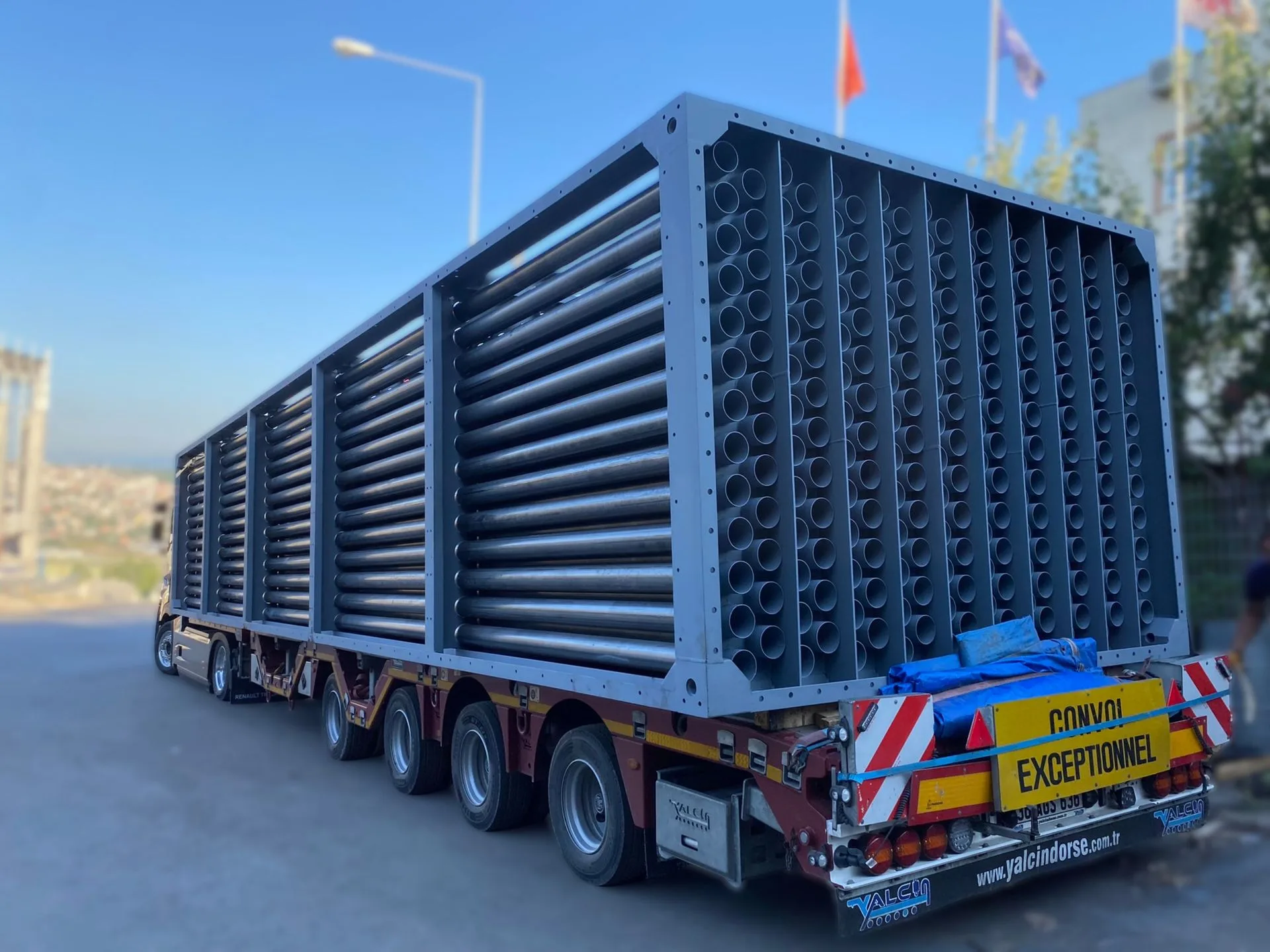
In the industry this equipment is also known as a forced draft cooler, natural draft cooler, air-to-air heat exchanger, air-cooled heat exchanger, or flue gas cooler. The natural draft type is also referred to simply as a natural cooler.
Flue gas leaving an electric arc furnace is around 1,300°C. Baghouse filter fabrics can't withstand that — even the most heat-resistant fabric tops out at 260°C. Cooling the gas is therefore mandatory.
But cooling has a lower limit too. If the gas drops below the acid dew point, condensation begins: bags blind, ducts corrode. The cooler's job isn't to cool the gas as much as possible — it's to keep it between the two limits.
There's a third constraint: dioxins. They form in the 250–450°C band. Passing through this window quickly matters more than cooling slowly. A gas cooler operates in the narrow band where these three constraints intersect.
| Custom design to client heat transfer requirements |
| High-temperature and corrosion-resistant material options |
| Warranty period: 12 months |
Filter fabrics have a limited continuous operating temperature. The U.S. EPA's Air Pollution Control Cost Manual gives the maximum continuous operating temperatures recommended by the Institute of Clean Air Companies: polypropylene 93°C, polyester (Dacron) 135°C, aramid (Nomex) 191°C, PPS (Ryton) 191°C, PTFE (Teflon) 232°C, P84 246°C, fiberglass 260°C. Gas leaving the furnace is around 1,300°C — even the most heat-resistant fabric operates at one-fifth of that. Without cooling, the filter is destroyed within minutes. Source: EPA Air Pollution Control Cost Manual, Section 6, Chapter 1, Table 1.6 (EPA/452/B-02-001); values attributed to the Institute of Clean Air Companies. On the line, the gas cooler sits ahead of the baghouse filter, after thecombustion chamber and the water-cooled duct.
No. The lower limit on cooling is the acid dew point. Sulfur compounds in flue gas condense as sulfuric acid below a certain temperature. Once condensation starts, two things happen: dust binds inside the fabric rather than on its surface, blinding the bags; and ducts and casings begin to corrode. Cooling is therefore controlled — the target is to drop below the temperature the fabric can tolerate while staying above the dew point. The dew point depends on the gas's sulfur and moisture content and is specific to each plant. Source: Batliboi Environmental Engineering, forced draft cooler technical description.
Because dioxins form within a specific temperature band. PCDD/F compounds form via de novo synthesis between 250–450°C, with formation rate peaking around 350°C. The longer the gas stays in this band, the more dioxin forms. In practice, gas is dropped from 1,300°C to 250°C within 1–2 seconds specifically to cross this window before dioxins can form. For the same reason, waste heat recovery can't go below 600°C — holding heat within that band means producing dioxins.
Both are used; the choice depends on the plant. A natural draft cooler has no fan — air moves by natural convection as it heats around the tubes. No moving parts, no energy consumption, low maintenance. In exchange, cooling capacity depends on ambient air temperature and stack height — it drops in summer. A forced draft cooler places fans between the tube banks. Because air is forced through, heat transfer is higher and controllable; cooling output can be adjusted via fan speed. In exchange, it consumes energy and requires fan maintenance. DNL manufactures both types; the choice is made based on the plant's layout, available space, and target outlet temperature. Source: Batliboi Environmental Engineering, for the comparison showing forced draft achieves higher heat transfer than natural draft.
The operating principle is the same; the fluids are different. In process industries, "heat exchanger" usually means a liquid-liquid or oil-water unit — fluid to be cooled on one side, water or oil circulating on the other. In a gas cooler, both sides are air (an air-to-air heat exchanger). Hot flue gas passes through the tubes; ambient air passes around them. There's no cooling fluid, no circuit, no pump. The only moving part — if present — is the fan. This difference is decisive for maintenance: there's no cooling circuit to leak, no secondary fluid to foul, and no freezing risk.
Tube diameter and count are calculated from the gas flow to be cooled and the target outlet temperature. There's no standard size — each unit is sized per plant. DNL's delivered projects have used Ø90 mm and Ø130 mm tube. Diameter is determined project-by-project based on gas flow and available space.