Dedusting Systems
Water-cooled combustion chamber — high-temperature resistant design for EAF process gases.
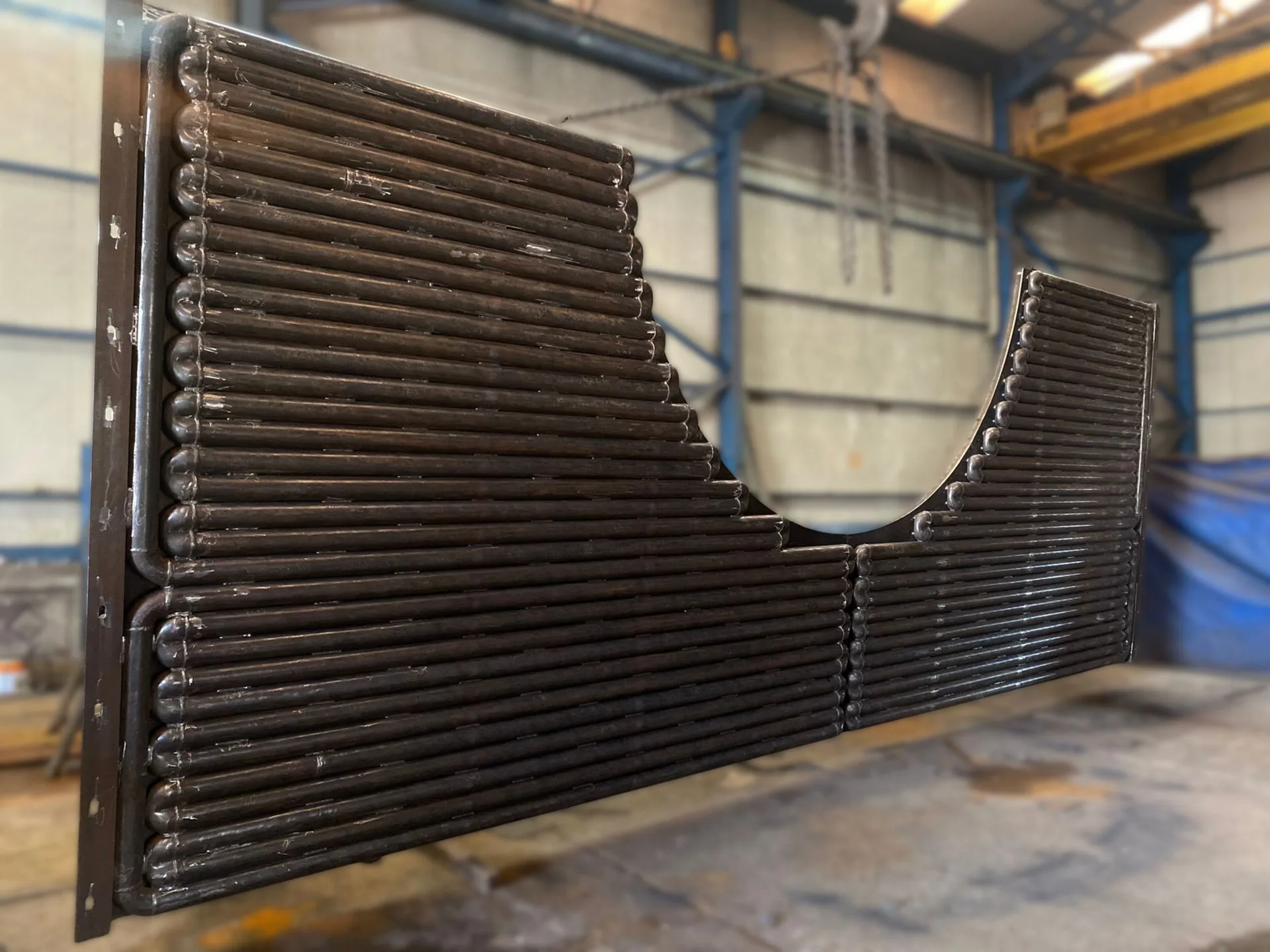
| Water-cooled high-temperature design |
| Custom geometry to client plant layout |
It fully burns the carbon monoxide and hydrogen remaining in the flue gas. According to the European Commission's Best Available Techniques (BAT) Reference Document for Iron and Steel Production, its primary purpose is to prevent uncontrolled reactions in the gas cleaning equipment. Reducing organic compounds such as polychlorinated dibenzo-dioxins, furans, PAHs and PCBs is a secondary benefit.
Three variables: residence time, turbulence and temperature. The same BAT document names all three together and states that all three must be sufficient for organic micro-pollutants to be burned off. The chamber is fitted with fossil-fuel burners to reach the temperature needed to break down persistent organic pollutants.
To prevent dioxin formation. The BAT document states that immediately after final combustion, the gas must be brought below 250°C as quickly as possible, at which point the risk of de novo synthesis is eliminated entirely. Cooling is achieved sometimes by dilution from a secondary circuit, but most commonly by water spraying in a cooling tower. Further down the line, the gas is cooled before the baghouse filter in agas cooler.
Not negligible. According to the BAT document, the energy required to reach the temperature needed to break down persistent organic pollutants is on the same order as the savings from scrap preheating. The heat released usually isn't recovered; recovery is only possible via the cooling water where available.
In water-cooled steel construction, matched to the plant's gas flow and layout. DNL Mühendislik designs the combustion chamber together with the other equipment in the flue gas chain.