Filtration Systems
Dampers that regulate industrial gas flow — narrowing or widening the duct cross-section to adjust draft. In addition to standard damper manufacturing, motorized damper systems are also produced; motorized dampers are preferred for flow control in automated lines.
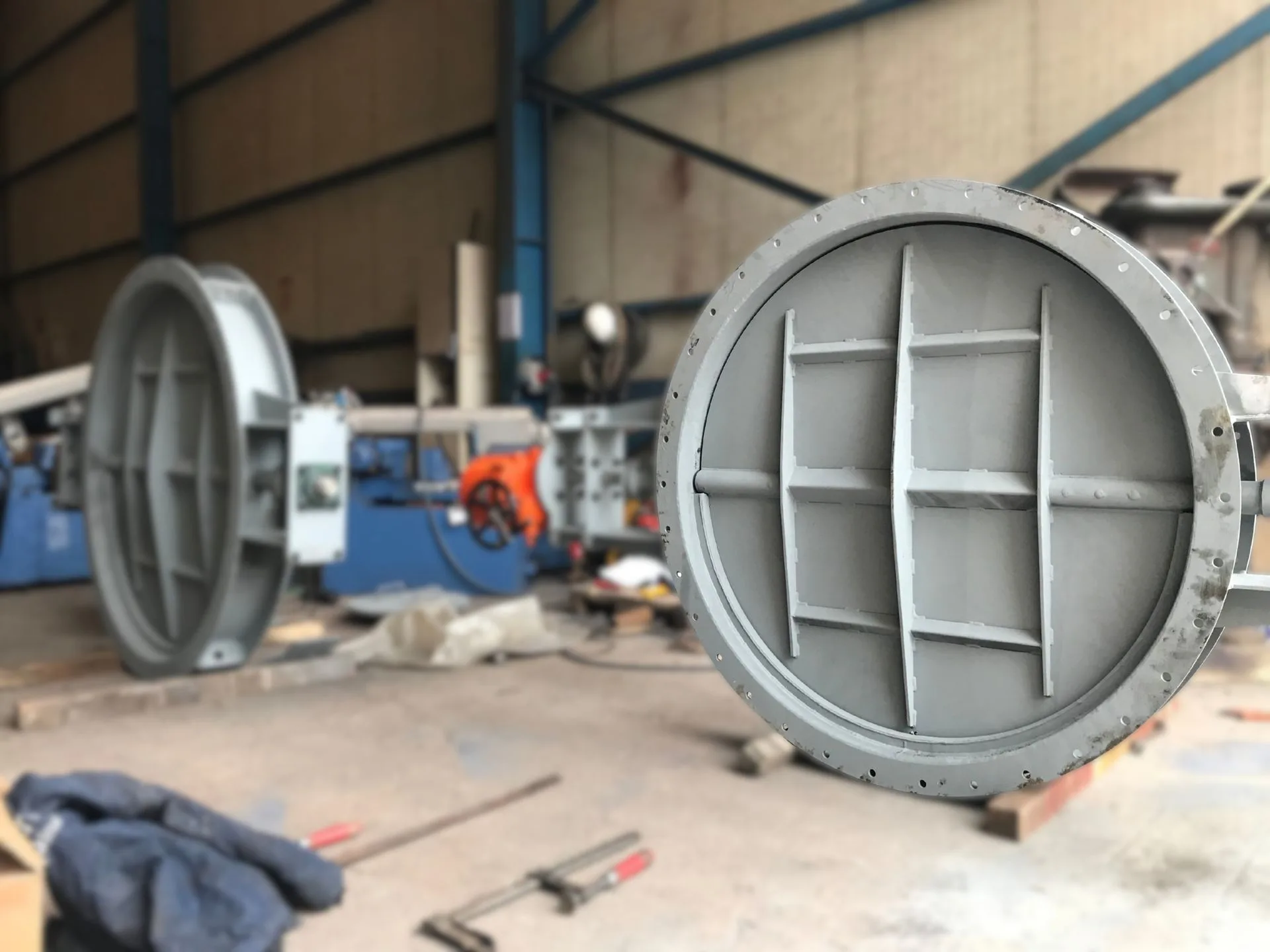
| Design suited to varied process gas conditions |
| Manual or actuated control options |
In a dedusting line, the fan runs at a fixed capacity, but the furnace's demand isn't constant — gas flow differs between charging, melting, and tapping. A damper closes that gap: it narrows or widens the flow cross-section to adjust draft. Adjusting with a damper, rather than throttling the fan, lets the system deliver the required draft at every operating point. In multi-branch systems, the damper also determines how much each branch draws — the split between primary draft (the fourth hole) and secondary draft (the roof canopy hood) is managed this way.
A louver-type damper has a single disc seated in the duct cross-section. The disc is mounted on a shaft running through its diameter and rotates between 0–90°. Fully open, the disc sits parallel to the flow and pressure loss is low. As it rotates, the cross-section narrows and resistance to flow increases. The disc never leaves the flow path entirely — even fully open, the shaft and disc thickness remain as an obstruction. This makes the damper well suited to regulation but poorly suited to full closure. In the closed position there is leakage around the disc's perimeter — this isn't a flaw, it's inherent to the design. Where full sealing is required, a separateisolation element is used.
The temperature a damper sees depends on where it sits in the line. Near the furnace outlet, gas is above 1,000°C; after the cooler and before the baghouse filter, it drops to around 200°C; it falls further at the filter outlet. Material and gasket selection is made based on this location. In high-temperature zones, thermal expansion must also be accounted for — if the disc and housing expand at different rates, binding or excessive clearance results. A damper's temperature rating isn't a property of the damper itself — it's a consequence of where it's installed.
A manually operated damper is sufficient where the setting is adjusted once and left. A motorized damper is used where the setting must change during operation: increasing draft as the furnace moves into the tapping phase, or continuously tracking flow against a control signal in automated lines. DNL manufactures motorized damper systems alongside standard dampers; this is the preferred solution for flow control on automated lines.
Duct diameter alone isn't enough for sizing. What's needed: duct diameter or cross-section, design gas flow and the velocity at that flow, gas temperature at that point, operating pressure and its direction, dust loading and abrasiveness, actuation type (manual, pneumatic, electric), and the sealing level expected in the closed position. That last point is most often skipped, and it leads to the wrong product being selected. If full closure is expected, an isolation element is needed, not a damper.