Electric Arc Furnace (EAF) Components
Water-cooled steel panels for EAF and LF applications — mechanical strength and low maintenance cost. Panels use boiler-tube grades: P265GH-TC1 (seamless/drawn), P235GH-TC1, A106 Gr.B and equivalents.
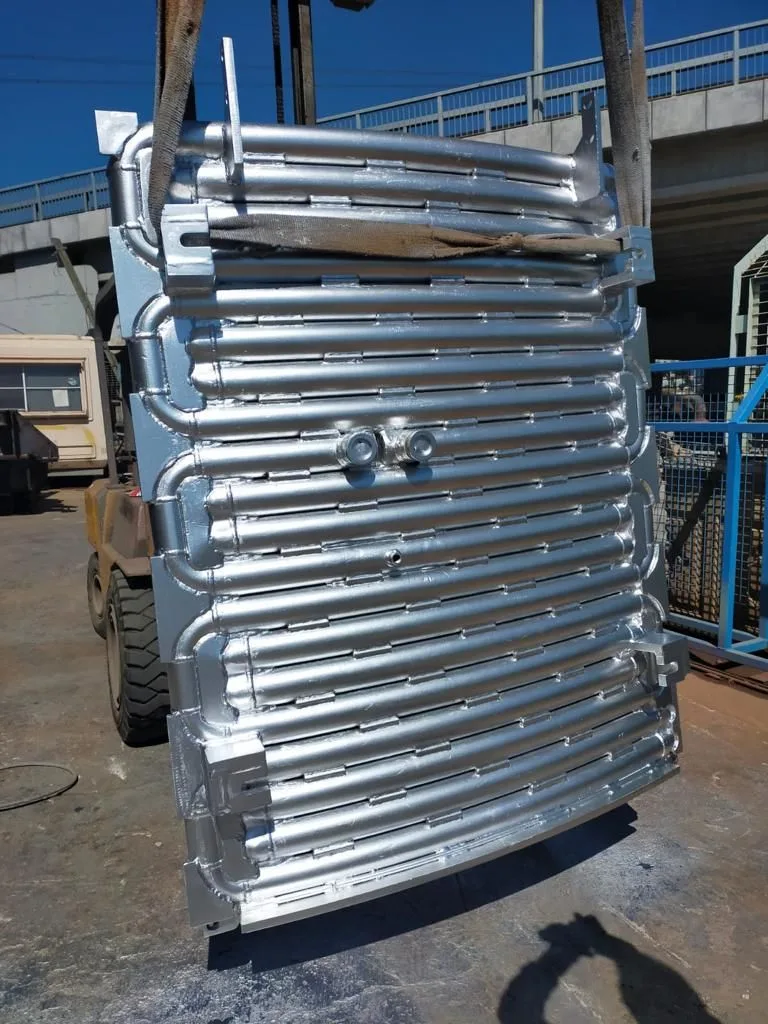
| Material: boiler-tube grades — P265GH-TC1 (seamless/drawn), P235GH-TC1, A106 Gr.B and equivalents |
| Operating pressure: 6–12 bar (project-specific) |
| Welding standard: EN ISO 3834-2 |
| Pre-delivery hydraulic pressure and leak test |
| Warranty period: 12 months |
The average and the peak differ sharply. In Toulouevski and Zinurov's measured data for a 130-tonne furnace, heat carried away by water per heat is 77 kWh/tonne, total wall and roof panel area is about 80 m², and for a 38-minute heat time this works out to an average flux of 199 kW/m²; modern furnaces run in the 200–300 kW/m² range. Peak values are far higher: the same source's Table 12.2 gives 600–700 kW/m² for wall and roof panels. Panel design follows the peak, not the average.
The crust acts as an insulating layer and reduces heat loss to the water. According to Toulouevski and Zinurov, crust thickness ranges from 3–5 mm to several centimeters, and this porous layer's thermal conductivity is much lower than the panel metal's. The crust surface reaches about 1300°C. But as heat flux rises, this temperature can exceed the crust's melting point; the crust starts thinning and can melt away completely within minutes at very high flux. Heat loss in that area then rises several-fold, and the panel takes the full load.
The tube arrangement is changed. Toulouevski and Zinurov cite Danieli's two-layer tube arrangement as an example: tubes in the inner layer facing the furnace are spaced markedly wider apart than those in the outer layer. This arrangement promotes formation of a thicker crust and better crust retention on the tubes. As freeboard volume increases, sidewall area — and with it heat loss to the water — rises, which is why this measure matters.
DNL Mühendislik uses boiler-tube grades — P265GH-TC1, P235GH-TC1, A106 Gr.B and equivalents. The choice is made against the fire-side surface temperature limit of roughly 400°C for low-carbon steel; Toulouevski and Zinurov state that above this limit, wear accelerates and burn-back can follow in a short period.
From the measured water flow, inlet and outlet temperature, and panel area. DNL Mühendislik'spanel cooling diagnostic tool calculates heat flux, water-side wall temperature and the boiling point at that pressure from this data; if the water-side wall temperature exceeds the boiling point, local boiling has begun in the panel.
We compared where steel and copper panels are used in the furnace, calculated from published data:Water-cooled EAF panels: steel or copper?