Electric Arc Furnace (EAF) Components
Water-cooled elbows are used at the gas outlet on EAF (Electric Arc Furnace) roofs and in off-gas ducts. The roof elbow provides initial directional flow for hot gases exiting the furnace, while the off-gas duct elbow forms the downstream duct geometry. DNL Mühendislik manufactures elbows from steel with internal water cooling to handle radiant heat load. The elbow can match the roof diameter when it is circular, but the cross-section is not always circular — elliptical and square sections are also used.
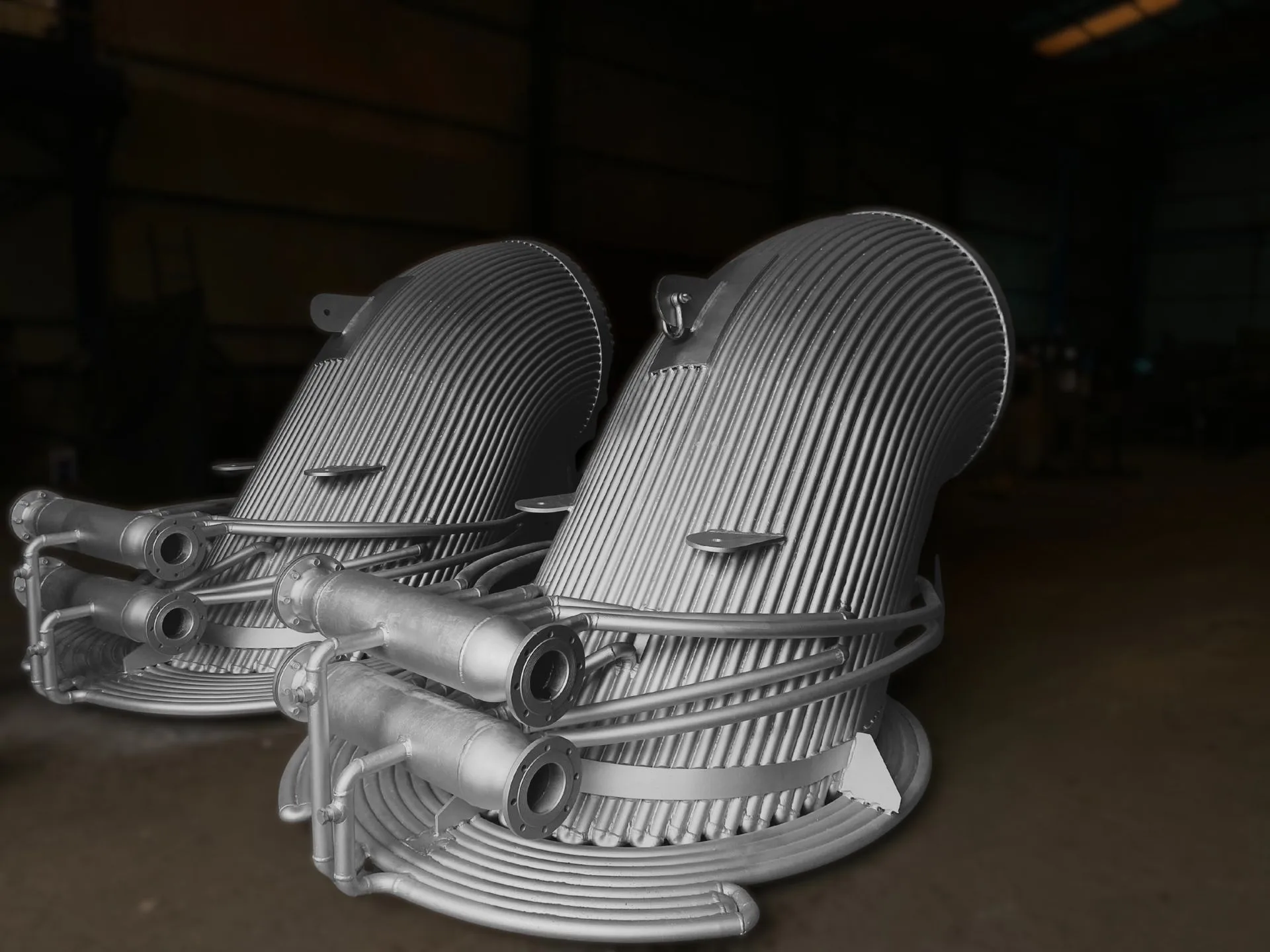
It is the water-cooled connecting piece that takes the 1300–1650°C flue gas leaving the fourth hole in the furnace roof. In the industry it is also known as the 4th hole elbow, fourth-hole elbow, DEC elbow and furnace top elbow. It is the first piece of equipment in the flue gas chain.
The actual-temperature volumetric gas flow divided by an acceptable gas velocity. In Toulouevski and Zinurov's worked example, a 1.25 m diameter roof elbow carries 36.7 m³/s of gas at 1650°C, at a gas velocity of 29.9 m/s. The cross-section is not a free choice: the same source states that as the diameters of the roof opening, elbow and duct shrink, the negative pressure required rises sharply. A smaller cross-section saves on steel and costs fan power.
No. When circular, it can match the roof diameter, but elliptical and square sections are also used. DNL Mühendislik manufactures all three cross-section types.
A numerical study by Soultanzadeh et al., published in SN Applied Sciences (2023, volume 5, article 99), shows that high heat flux combined with low-velocity core vortices creates hot spots at bends and elbows, and that mechanical damage results from the thermal stress at those hot spots. Flow distribution is therefore as decisive as the geometry itself.
DNL Mühendislik uses boiler-tube grades in its water-cooled elements — P265GH-TC1, P235GH-TC1, A106 Gr.B and equivalents. These grades are selected against the fire-side surface temperature limit of roughly 400°C for steel.