Electric Arc Furnace (EAF) Components
Water-cooled copper panels for EAF — superior thermal conductivity for high cooling performance at lower water temperatures. Water-cooled copper shields are also manufactured on the same production line. Shields provide additional protection at points exposed to radiant heat load. Panels are manufactured in 99% copper, Cu-ETP or Cu-DHP grade.
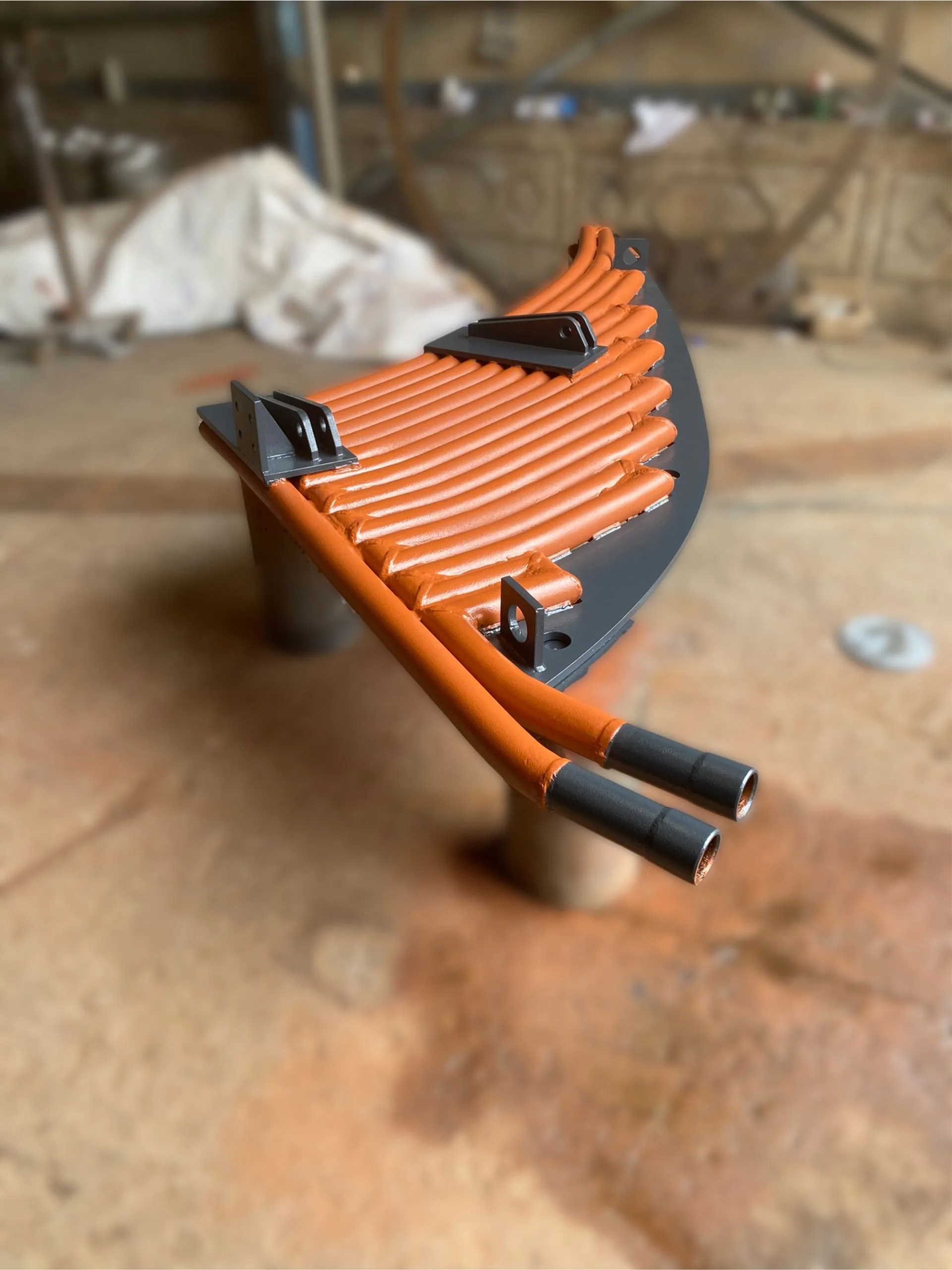
| Material: 99% copper — Cu-ETP or Cu-DHP |
| Manufacturing method: forging + machining or casting |
| Welding standard: EN ISO 3834-2 (dedicated copper welding procedure) |
| Pre-delivery hydraulic pressure and leak test |
It conducts heat much faster. According to the conductivity curves given by Toulouevski and Zinurov, rolled copper's thermal conductivity at 100°C is 385 W/m·K against 55.6 W/m·K for low-carbon steel — roughly seven times higher. At the same heat flux, a copper panel's fire-side surface temperature stays markedly lower, which is what makes copper the preferred choice in high-flux areas.
DNL Mühendislik uses 99% copper — Cu-ETP or Cu-DHP. Grade selection balances conductivity against weldability.
Toulouevski and Zinurov give a maximum fire-side surface temperature of about 300°C for copper and about 400°C for low-carbon steel. Despite the lower limit, copper is advantageous in practice: because its conductivity is seven times higher, the surface temperature at the same heat flux is already much lower. Reaching the limit requires a much higher flux.
Yes, a marked one. Toulouevski and Zinurov state that cast copper that is insufficiently deoxidized or insufficiently dense has thermal conductivity 15–20% lower than rolled copper. In addition, the 0.4% chromium added for thermal strength lowers conductivity by a factor of 1.5–2. Material selection therefore does not end with simply specifying "copper".
Because of flow distribution. A numerical study by Soultanzadeh et al., published in SN Applied Sciences (2023, volume 5, article 99), shows that high heat flux combined with low-velocity core vortices creates hot spots at bends and elbows, and that the mechanical damage results from thermal stress at these points. DNL Mühendislik designs the cooling circuit to avoid flow stagnation in these areas.
We calculated the heat load at which copper becomes necessary:Water-cooled EAF panels: steel or copper?
The cooling circuit's job is to keep the panel's outer-surface temperature below a critical value. For a copper wall that limit is ≈300°C (≈400°C for mild steel). Beyond it, wear accelerates and can lead to burn-through in short order. The reverse holds too: at low surface temperature, service life can be measured in years. That single quantity is the entire point of circuit design.
Minimum flow is found with a simple relation: V = Q / [1.15 · (t_out − t_in)] m³/h, with error under 1% across 20–60°C. The outlet temperature limit depends on water quality — in untreated water, 40–50°C shouldn't be exceeded to prevent salt deposits; even in treated water, above 70°C isn't wanted.
But the real constraint isn't outlet temperature — it's boiling. Once local boiling occurs, the wall's water-side surface temperature can't drop below the saturation temperature at that pressure. The system has to be designed so this temperature stays clearly below saturation. Example: a 40 mm channel, 3 m/s water, 30°C inlet, 3 bar abs. → saturation temperature of 133.7°C.
High water velocity alone isn't a guarantee. Even around 3–5 m/s, complex channel geometry produces high-frequency water hammer; in poorly washed sections behind sharp corners, flow separates from the wall and velocity drops to near zero for short periods. In those zones, bubble and film boiling alternate continuously — even without causing immediate burn-through, this sharply raises surface temperature and wear rate.
This is where the concept of a critical zone comes from: rapid wear of a small area there sharply shortens the whole panel's life. The critical zone is wherever peak heat flux concentrates, or wherever geometry can't carry enough water at sufficient velocity — the worst case is both coinciding. So circuit design doesn't end with hitting an average velocity; it ends with showing that flow doesn't separate from the wall at any cross-section.
Toulouevski & Zinurov 2013
You can check your own circuit's flow and temperature difference with thepanel cooling calculator.