Ladle Furnace (LF) Systems
Ladle furnace roof — high-temperature resistant, custom design and manufacturing. DNL manufactures the water-cooled steel roof structure.
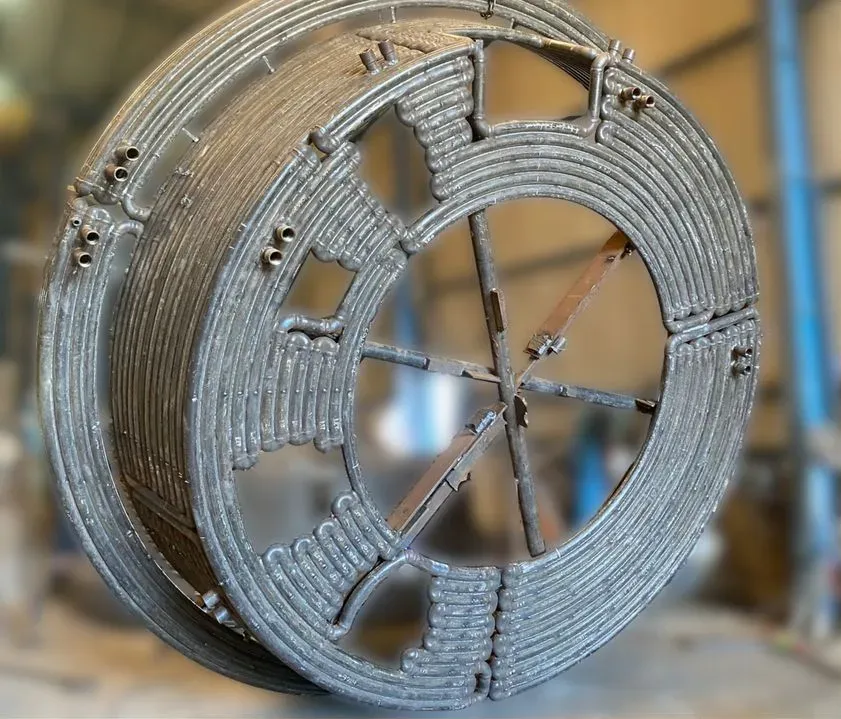
| Custom dimensions to client drawings |
| EN ISO 3834-2 certified welding quality |
The load on the roof isn't constant, and it isn't proportional to installed power. What decides it is how shrouded the arc is by slag.
A modeling study puts a number on this: with the arc buried in the melt, the roof's hottest point is ≈70°C; with the arc exposed at the surface, ≈330°C. Same roof, same furnace — the only difference is shrouding. The hottest point occurs at the roof's center under every condition.
The same rule shows up in EAF panels: maximum heat flux runs 600–700 kW/m², dropping to 200–300 kW/m² where the panel is heavily coated with slag.
What this means for design: the roof is sized to peak load, not average load. Peak loads are brief but recur on every heat; they're what causes early failures.
Zhang et al. 2009; Toulouevski & Zinurov 2013
Water-cooled walls and roofs have been standard practice since 1980. What it buys can be measured in one sentence: at low outer-surface temperature, service life is measured in years.
The critical threshold depends on material — ≈300°C for a copper wall, ≈400°C for a mild-steel wall. Past it, wear accelerates and can lead to burn-through in short order.
What happens above the threshold is also defined: under rapid temperature swings and slag attack, the material corrodes, spalls, and develops cracks that turn into water leaks. Even copper develops cracking at sufficiently high temperature.
The cost is documented too: water-cooled sidewalls and roofs add roughly 10–20 kWh/ton of extra energy. The EU BAT document notes this is offset by advantages in plant availability and maintenance.
EU JRC BREF 2013; Toulouevski & Zinurov 2013
The roof is the load-bearing, water-cooled steel shell covering the ladle: it carries the electrode openings, the flue-gas offtake connection, and the lifting lugs. At the electrode openings sits a refractory delta section with three openings; it shields the roof from electrode heat and routes flue gas to the offtake.
Two published shell families exist. Welded-tube shell — steel tubes welded to the main structure. In one modeled roof, tube inner diameter is 40 mm; cooling water runs a single circuit or a 2×180°/3×120°/4×90° segmented path. Channeled plate shell — the inner surface is steel plate (e.g. ASTM A516 Gr 70), seam-welded from the back to keep the inner face smooth. Channels are formed between the inner and outer surface.
The difference is decisive on the slag side: exposed tube, welds, and crevices collect slag that builds up like stalactites, adding weight and risking contamination if it falls into the melt. A smooth inner surface is chosen to reduce this.
The wall-thickness rule runs against intuition: thickening the wall for wear allowance shortens life rather than extending it — a thicker wall raises surface temperature.
US 8,858,867 B2; US 6,418,157 B1; Zhang et al. 2009; Toulouevski & Zinurov 2013
What sets the passage clearance isn't manufacturing tolerance — it's electrode movement. Current surges at melt start generate electromagnetic forces that deflect the electrodes laterally; the clearance exists for that movement. The scale is striking: electrode diameter tolerance runs around ±1 mm, while the annular clearance left is measured in centimeters.
There's a second, ladle-specific clearance, and its cause is slag: the annular gap between the roof and the ladle's top edge is typically no narrower than 150–200 mm because of buildup on the ladle. The air entering through it isn't trivial — it prevents production of certain low-nitrogen steel grades.
The way leakage is controlled isn't flow — it's pressure. A small negative pressure held under the roof eliminates uncontrolled dust and gas escaping through the electrode openings. A typical recorded error: selecting fans with adequate flow but not the pressure to create the required vacuum.
In a 200-ton ladle furnace with an annular air curtain applied, the pressure under the roof can be held at +5 Pa; the curtain's air consumption is ≈100 m³/h (6 bar).
US 6,377,605 B1; Toulouevski & Zinurov 2013; Zhang et al. 2009
Published circuit data: flow 120 m³/h, water velocity 2.65 m/s, tube inner diameter 40 mm, temperature difference across the circuit ≈10 K. Minimum flow is found with a simple relation: V = Q / [1.15 · ΔT] m³/h.
The outlet temperature limit depends on water quality — 40–50°C for untreated water because of salt deposits, above 70°C unwanted even in treated water.
But the real constraint isn't outlet temperature — it's boiling. Once local boiling starts, the wall's water-side temperature can't drop below the saturation temperature at that pressure; the system has to be designed to stay clearly below it.
And high velocity alone isn't a guarantee: flow separates from the wall behind sharp corners, velocity drops toward zero for an instant, and surface temperature spikes right there. Rapid wear of a small area in that critical zone shortens the life of the entire element; circuit design ends not by hitting an average velocity, but by showing flow doesn't separate anywhere.
A third wear path comes from maintenance: cleaning slag off with a chisel can deform the tube and restrict water flow.
Zhang et al. 2009; Toulouevski & Zinurov 2013; US 6,418,157 B1
You can check your own circuit's flow and temperature difference with thepanel cooling calculator.
Sources